TWO WORDS. A REAL PATH.
Word Ladder Solver
Loading word dictionary… You can enter words now; solving is available once loading finishes.
3–6 letter English words
Try the steps yourself
Play the Word Trail ladder word game for 100 reviewed practice ladders with 3, 4 or 5 shortest steps. Play today’s Daily on the home game, use Daily Archive to look back by date, or choose Practice to work at your own pace.
How to use this word ladder solver
Enter two same-length words of 3, 4, 5 or 6 letters, then choose Find shortest path. Next hint reveals one move at a time; Show full solution reveals the selected route. You can switch among up to three shortest routes, copy the selected path, exclude intermediate words, reverse the pair, share only the pair, or open the same pair in the Word Ladder Challenge without carrying its answer across.
- Choose your pair. Type the start and end words in the two labeled boxes. Use the same length, from three to six letters. Spaces around a word and uppercase letters are normalized; phrases, hyphens and accented letters are not accepted as English letter sequences here. Reverse words swaps the endpoints when you want to explore the other direction.
- Choose how much help you want. Find shortest path displays a complete selected route. To preserve the puzzle, use Next hint instead: the first hint shows the start and its next move, then each press reveals one more word. Show full solution reveals the rest of that selected route when you are ready. In hint mode, switching to another route starts its reveal at the first move. Find shortest path and Show full solution leave hint mode; switching routes then shows the full selected route.
- Read the result. Count arrows as changes, not words. Each move identifies the changed position and letter. Available routes can include up to three shortest candidates and a separately labeled reviewed-word route when that route is longer. A reviewed route is a vocabulary preference, not a claim that a longer answer is shortest. The tool does not enumerate every possible answer.
- Adjust or reuse it. Open Exclude words to avoid intermediate words, separating entries with spaces, commas or new lines. The endpoints remain allowed. Search again after editing exclusions. Copy path copies the selected route, including its answer. Copy link shares the pair and vocabulary setting. Play this ladder opens the Challenge game for the same endpoints without transferring the answer.
Share a puzzle without sharing its answer
The pair in a shared link is readable after the # in the address. Opening that link restores the two words and vocabulary setting, then recalculates a route; it does not restore your excluded words, selected alternative, hint position or unsaved edits. Tell the recipient about any extra classroom rules separately. Copy path appears once the selected route is fully revealed and deliberately includes its solution. Copy link reopens this solver and recalculates a full route. To let someone solve without seeing that route, choose Play this ladder and share the Challenge link.
Challenge checks each submitted move against its dictionary and keeps its own progress in this browser. It does not replace your home Daily, Practice or five-letter practice saves. You can return to Solver for help, but opening a solver answer is your choice. There is no account sync between devices. A private browsing window or clearing site storage can remove locally saved game progress.
Recover from loading or search problems
A dictionary loads only when its word length is needed. If loading fails or times out, check your connection and use Retry loading; changing a word does not require a new account or purchase. A missing word is an input problem, while an accepted pair with no route is a search result. First remove optional exclusions to see whether they blocked the connection. If a route still cannot be found, choose different endpoints or compare your worksheet’s own accepted vocabulary with this site’s list. Do not replace a missing intermediate word with an invented spelling.
Eight worked examples in the full dictionary
Each route below is a shortest path in this site’s fixed dictionary. A step is a change between two words: five words make four steps. Alternative shortest routes may use different words.
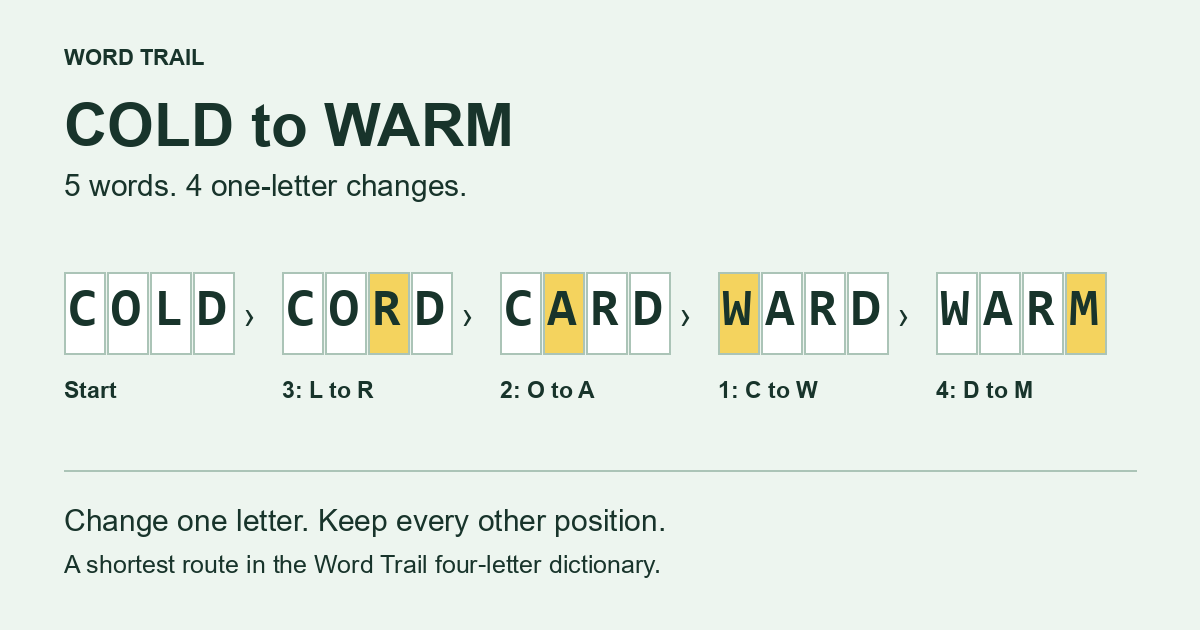
- COLD → CORD → CARD → WARD → WARM
Four steps. Change letter 3, L→R; letter 2, O→A; letter 1, C→W; then letter 4, D→M. All four differing positions must change, so fewer than four steps cannot work.
- RICE → RACE → RARE → CARE → CORE → CORN
Five steps. The changes are letter 2 I→A, letter 3 C→R, letter 1 R→C, letter 2 A→O, then letter 4 E→N. Position 2 changes twice: sometimes a useful detour is necessary.
- LEAD → LOAD → GOAD → GOLD
Three steps: letter 2 E→O, letter 1 L→G, then letter 3 A→L. Every intermediate word is accepted here. Three differing positions give a lower bound of three changes, reached by this route.
- HEAD → HEAL → TEAL → TELL
Three steps, not four: letter 4 D→L, letter 1 H→T, then letter 3 A→L. Count the arrows, not the words. The solver may offer another equally short route first.
- FIRE → HIRE → HERE → HERD → HEAD → HEAT
Five steps: letter 1 F→H, letter 2 I→E, letter 4 E→D, letter 3 R→A, then letter 4 D→T. The final letter takes a detour through D before becoming T.
- CAT → COT → DOT → DOG
Start CAT, target DOG: three changes. Position 2 A→O gives COT; position 1 C→D gives DOT; position 3 T→G reaches DOG. Three positions differ between the endpoints, so this three-change route reaches the lower bound. Use it to practise checking the unchanged positions: a short word still requires a complete word at every move. The solver can show a different equally short route.
- APPLE → APPLY → APTLY
Start APPLE, target APTLY: two changes. Position 5 E→Y gives APPLY; position 3 P→T gives APTLY. The two differing positions require at least two moves, and this route meets that bound. Use it to separate word length from step count: five letters do not mean five steps. Check that learners understand APTLY before using this pair, and compare it with the smaller Five-Letter Practice dictionary rather than assuming the lists match.
- FATHER → FOTHER → MOTHER
Start FATHER, target MOTHER: two changes. Position 2 A→O gives FOTHER; position 1 F→M gives MOTHER. Two differing positions give a two-change lower bound, reached here. FOTHER is an uncommon dictionary entry; inspect its meaning before presenting this example. Use this route to discuss why an accepted shortest answer may be unsuitable for a familiar-vocabulary exercise. Six letters and a low step count do not establish reading level or classroom suitability.
Word length and step counts
3-letter word ladders
Three-letter pairs use the 1,311 three-letter entries in our pinned dictionary. Try CAT → DOG above. Short words can have many branches, so inspect uncommon results before using a route with children or learners.
4-letter word ladders
These ten pairs are accepted by the current dictionary. The number is the shortest number of changes, not the number of words or a promise of difficulty. Some shortest paths include unfamiliar words; inspect the result before choosing a puzzle for someone else.
- COLD → WARM: 4 steps
- RICE → CORN: 5 steps
- LEAD → GOLD: 3 steps
- HEAD → TELL: 3 steps
- FIRE → HEAT: 5 steps
- HEAD → TAIL: 4 steps
- LOVE → HATE: 3 steps
- MOON → STAR: 5 steps
- HAND → FOOT: 4 steps
- BOOK → READ: 4 steps
5-letter word ladders
The solver searches 12,653 five-letter entries from the pinned source. For a smaller reviewed experience, Five-Letter Practice remains a separate practice game with 12 selected challenges and a 199-word accepted list.
6-letter word ladders
Six-letter pairs use 22,418 entries from the same fixed CC0 source and load only when a six-letter pair is requested. The larger list has more isolated and uncommon words, so a valid endpoint can still have no route and every displayed result needs review.
3 steps, 4 steps or 5 steps?
This solver finds a minimum; it has no exact-step selector. If it reports three steps, a worksheet requiring five changes adds a different constraint. Do not pad the answer with repeated words. For reviewed three-, four- or five-step puzzles, use the step groups in Word Trail Practice. A longer ladder is not always harder: familiar vocabulary and the number of available choices also matter.
Which words actually connect?
Think of each accepted word as a point, linked to words differing at exactly one position. Connected groups let you travel between their words; separate groups cannot be joined by wishing a missing word into the list. A real English word can still be absent from this particular dictionary.
COLD → ECRU has no solution here. Both words are accepted, but ECRU is isolated: it has zero one-letter neighbors in this list. Changing one of its letters never reaches another accepted word. This is different from ZZZZ, which is rejected before a search begins. Try COLD → WARM to return to a connected pair.
These twelve connection-rich words can help you explore. Counts are immediate one-letter neighbors in our fixed list, not counts of complete routes or common vocabulary:
- CARE (37)
- DARE (29)
- FARE (31)
- HARE (32)
- MARE (38)
- RARE (26)
- RATE (31)
- DATE (22)
- LATE (30)
- MATE (31)
- CORE (35)
- BORE (29)
The -ARE, -ATE and -ORE endings offer several choices, but sharing an ending does not guarantee a route to your goal. Neighbor counts include uncommon and adult words. Check the dictionary source and limitations when comparing answers from different tools.
How to solve a ladder without the solver
- Count differing positions. Each must change at least once. That count is a lower bound, not a guarantee that a route of that length exists.
- List legal moves from both ends. Write one-letter neighbors of the start and the goal, then expand a layer at a time. Look for a meeting word. Keep the routes on paper so you can join them without losing a step.
- Try a different position when stuck. Test consonants and vowels rather than insisting on one rule about which comes first. A useful intermediate word may temporarily move away from the target.
- Avoid revisiting words. Record what you have tried. Explore all shallower layers before claiming a shortest answer; the first route you happen to notice is not necessarily minimal.
- Verify every word and arrow. No rearranging, adding or deleting letters. If the worksheet supplies clues or a special word list, those extra rules take priority over an answer from this tool.
For teachers and parents
Prepare a five-minute exercise by selecting a reviewed Practice pair, checking its words, and asking learners to explain each one-letter change before revealing the route. Start with familiar words and a three-step minimum, then try four or five. Leave room for alternative valid answers rather than requiring one exact chain.
You can print this page with your browser’s Print command or copy a checked pair onto paper and keep its solution separately. For blank puzzle sheets and separate answers, use the Worksheet Generator. These dictionaries are not children’s safe word lists. They include adult and uncommon words; even a short route needs adult review before classroom or family use. Inspect all results you plan to show, including alternatives. For less help during practice, use the game’s staged hints rather than revealing a complete solver answer.
Playing Poople? See the Poople solver for a path from today's starting word to POOP.
Word ladder solver questions
Does this find the shortest path?
Yes, within our fixed dictionary. Each one-letter change counts as one step. Several shortest paths can exist; we show up to three, with reviewed words preferred. Identical start and end words need zero steps. Reviewed-word routes are labeled separately if they are longer.
Which word lengths and words work?
Same-length 3-, 4-, 5- and 6-letter pairs work when both words appear in their fixed lists: 1,311, 5,528, 12,653 and 22,418 entries respectively. Some valid English words are missing, while uncommon and adult words are included. A bounded filter skips a small known set of sensitive intermediate words, but endpoints remain allowed and coverage is not comprehensive. This is not a filtered children’s dictionary or a guarantee of another game’s accepted answers.
For reviewed five-letter play, try five-letter practice. Its smaller accepted list and selected puzzles differ from this automatic solver.
Why is a word rejected, or no path found?
A rejected word has an unsupported length, does not match the other word, or is missing from that length’s list. No path means both words are accepted but no chain connects them under the current exclusions. ECRU is an accepted but isolated four-letter example.
What is a word ladder?
A word ladder connects two words of the same length by replacing one letter at a time. Every intermediate entry must be accepted. This solver supports the basic rule for 3–6 letters and optional banned intermediate words.
Is there a solver that gives you letters?
Our result spells out every word and labels the position and replacement letter on each move. Next hint reveals one move at a time; Show full solution reveals the selected route. It does not fill clue-based worksheets or accept a pool of loose letters.
How many steps is a typical ladder?
There is no universal count: the pair and dictionary decide the minimum. Word Trail Practice groups reviewed puzzles into three, four and five shortest steps. Include both endpoints when counting words; a four-step route contains five words.
What is the difference between a word ladder and Wordle?
A ladder shows the start and goal and asks you to connect them through legal words. Wordle asks you to identify a hidden word from guess feedback. For other guessing formats, see Games Like Wordle; those rules do not make a word legal in this solver.
Do I need an account?
No account, payment or sign-in is required. Solving runs in your browser. Shared links contain the two words in a readable fragment; anyone with the link can see the pair. Social previews use the fixed COLD → WARM illustration, not your chosen words. See our privacy information and analytics choices.
How can I share a puzzle without revealing the solution?
After checking the pair, choose Play this ladder. On the Challenge page, use Copy link under Share this puzzle and send that link to the learner. It carries the endpoints without the answer. Copy path deliberately includes the solution, while Copy link on this solver opens a page that recalculates and displays a full route. Keep those answer-bearing options for someone who wants help. Opening Challenge starts or restores its separate local trail; it does not change home Daily or Practice progress.
Can excluding a middle word change the answer or make a pair unsolvable?
Yes. Open Exclude words, enter dictionary words of the same length separated by spaces, commas or new lines, then search again. Removing a bridge can force a longer route or leave no route under those restrictions. Exclusions apply to intermediate words; excluding the start or target does not forbid that endpoint. Remove optional exclusions and rerun the search to distinguish a restriction from a disconnected pair. Do not label the old result valid under newly edited rules.
Which settings does a shared solver link restore?
Only the normalized start and target words are restored from the fragment. The page loads the appropriate dictionary and computes a new answer. It does not restore excluded words, the selected alternative, hint progress or unsaved edits. If your exercise bans a word, requires an exact number of changes or uses a special vocabulary list, send those instructions separately. The recipient must re-enter exclusions in Solver; Challenge does not receive that exclusion list. A link therefore identifies a pair, not a complete assignment specification.
How do I hand out blank sheets and keep an answer key?
For four-letter pairs, open the Worksheet Generator, enter the endpoints and select Create worksheet. Review Show answer separately first. Use Print blank worksheet for learners and Print answer only for your key. A route with four changes has five word rows, with three blank middle rows. On-screen guesses do not fill those printed blanks. This generator accepts four letters only; copy a checked three-, five- or six-letter example onto your own sheet instead. An answer key shows one route, and other valid routes can exist.
Source and privacy
Calculations run in your browser using original Word Trail route selection and the MIT poople 0.1.0 dictionary utilities and Loren Brichter’s pinned CC0 Words list. Our interface and sharing implementation are original. See sources and licenses and Privacy. Refresh clears unsaved edits; a shared link restores only its word pair. No account or database is used.